Day 3: The Room Next Door – Hotels Are on the Front Line Against Human Trafficking
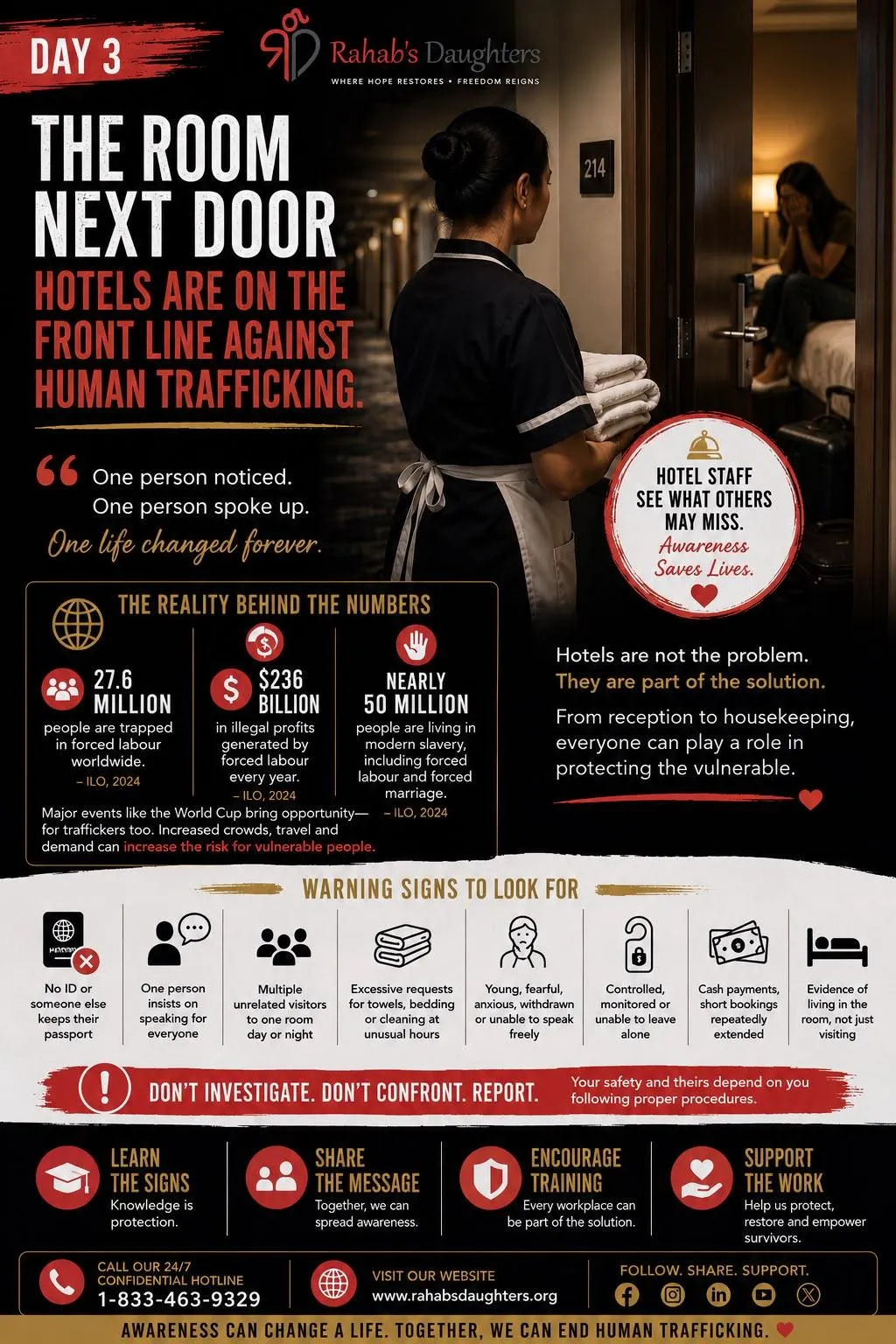
“I cleaned her room every morning for three days.”
The housekeeper couldn’t stop thinking about the young woman.
Every morning she found untouched food on the bedside table.
Every morning there were multiple mobile phones charging.
Every morning there were men’s clothes scattered around the room—but only one small backpack that appeared to belong to the young woman.
She rarely made eye contact.
When she did speak, it was barely above a whisper.
A man answered every question for her.
The housekeeper assumed they were just another couple visiting for the tournament.
Until she noticed something else.
The young woman never had a room key.
She never left alone.
Every time she walked through the hotel lobby, someone was watching her.
Something didn’t feel right.
Rather than confronting the man, the housekeeper followed her hotel’s safeguarding procedures and alerted management. Law enforcement was contacted, and the young woman was identified as a victim of human trafficking.
One person noticed.
One person spoke up.
One life changed forever.
⸻
Human Trafficking Doesn’t Need a Dark Alley
One of the biggest misconceptions about human trafficking is that it happens in secret locations far away from the public.
The truth is much more unsettling.
Trafficking often happens in places we use every day.
Hotels.
Motels.
Holiday rentals.
Restaurants.
Transport hubs.
Major sporting events can bring hundreds of thousands of visitors into one city. Most visitors come to celebrate football, but traffickers can exploit the increased demand for accommodation, transport, food services, and commercial sex.
Hotels are not the problem.
They are often one of the greatest opportunities to identify and protect victims.
⸻
Why Hotels Matter
Hotel staff are uniquely positioned to notice patterns others may miss.
A receptionist notices who checks in.
A housekeeper notices what happens inside the room.
Security notices unusual movements.
Maintenance staff notice repeated visitors.
Restaurant staff notice who eats—and who doesn’t.
Everyone sees a different piece of the puzzle.
Together, those observations can save lives.
⸻
Warning Signs Hotel Staff Should Know
While no single sign proves trafficking, several indicators together should raise concern:
* A guest who has no identification or someone else keeps their passport.
* One person insists on speaking for everyone.
* Multiple unrelated men visiting one room throughout the day or night.
* Excessive requests for towels, bedding, or room cleaning at unusual hours.
* Young people who appear frightened, anxious, withdrawn, or unable to speak freely.
* Guests who appear controlled, closely monitored, or unable to leave alone.
* Cash payments combined with very short bookings that are repeatedly extended.
* Evidence that someone is living in the room rather than simply visiting.
The most important thing to remember is this:
Don’t investigate. Don’t confront. Report.
Traffickers can be dangerous.
Your role is not to rescue someone yourself.
Your role is to recognise concerns, document what you observe, and follow your organisation’s safeguarding procedures or contact the appropriate authorities.
⸻
Rahab’s Daughters Believes Everyone Has a Role
At Rahab’s Daughters, we’ve trained thousands of professionals because we know that awareness saves lives.
The person who recognises trafficking is not always a police officer.
Sometimes it’s a cleaner.
Sometimes it’s a concierge.
Sometimes it’s a waiter.
Sometimes it’s a taxi driver.
Sometimes it’s simply someone willing to trust their instincts and speak up.
Human trafficking survives in silence.
Freedom begins when someone notices.
As the World Cup continues, remember this:
The most important person in the hotel may not be the VIP checking into the penthouse.
It may be the frightened young woman in Room 214 who is praying that someone will notice she needs help.
Will you be that person?
⸻
Take Action Today
✅ Learn the warning signs.
✅ Share this article with someone who works in hospitality.
✅ Encourage your workplace to provide trafficking awareness training.
✅ Support organisations like Rahab’s Daughters that work every day to prevent exploitation, educate communities, and walk alongside survivors on their journey to freedom.
Because every room has a story. Let’s make sure it ends with hope, not exploitation.
Call 1-833-4newday if you need help.
To keep our work going please donate.