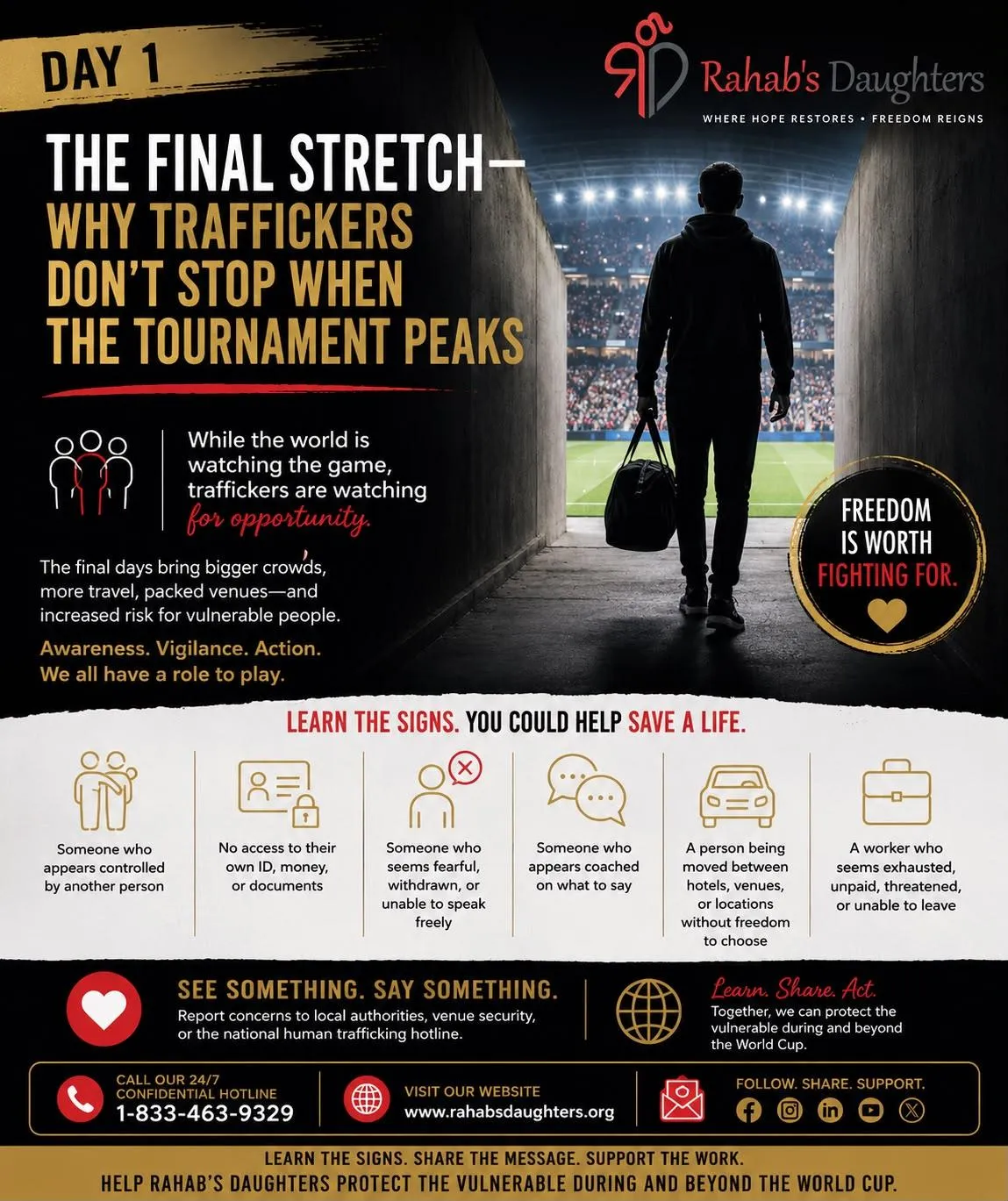
Day 1: The Final Stretch — Why Traffickers Don’t Stop When the Tournament Peaks
In 1996, while thousands of people gathered to celebrate one of America’s biggest sporting events, my life looked very different.
I was being trafficked.
While fans were filling stadiums, watching the game, and making memories with family and friends, I was living through exploitation that most people around me never saw. To those passing by, I looked like just another person in a busy city. No one knew what was happening behind the scenes.
That experience has shaped my life’s mission.
Today, as the World Cup enters its final days, millions of people around the world are celebrating the beautiful game. Cities are alive with excitement. Hotels are full. Restaurants are busy. Airports are crowded. Families are travelling. Businesses are thriving.
Unfortunately, traffickers see these same circumstances as opportunities.
It is important to separate fact from fiction. Major sporting events do not automatically cause spikes in human trafficking, and researchers continue to debate exactly how much trafficking increases around these events. What we do know is that large gatherings create environments where vulnerable people can be targeted and existing victims can be exploited, making awareness and prevention essential.
The final stretch of a tournament can create conditions that traffickers exploit: increased travel, temporary work, high demand in hospitality and entertainment, online conversations with strangers, and people letting their guard down because they are caught up in celebration.
That is why awareness matters now.
We do not need fear. We need vigilance.
We need hotel workers, taxi drivers, restaurant staff, volunteers, football fans, churches, businesses, and families to know the warning signs:
* Someone who appears to be controlled by another person.
* Someone who has no access to their own identification or money.
* A young person who seems fearful or unable to speak freely.
* Someone who appears coached on what to say.
* A worker who looks exhausted, threatened, unpaid, or unable to leave.
* A person being moved frequently between hotels, venues, or locations.
You do not need to be an investigator to make a difference.
If something doesn’t feel right, trust your instincts. Never place yourself in danger by confronting a suspected trafficker. Instead, observe carefully and report your concerns to local law enforcement, venue security, or the appropriate human trafficking hotline.
At Rahab’s Daughters, we believe prevention saves lives. Every conversation, every training session, every volunteer, every business that learns the signs, and every person willing to speak up helps make exploitation harder and freedom more possible.
I survived because people eventually saw me.
Today, countless others are still waiting for someone to notice.
As the World Cup continues, let’s make sure that while the world watches football, we also watch out for one another.
For the next 10 days, Rahab’s Daughters will share practical ways you can help prevent human trafficking. Together, we can ensure that hope—not exploitation—has the final whistle.
Call 1-833-4newday to report anything or if you need help.
Donate to assist us in helping women and children out or modern slavery